
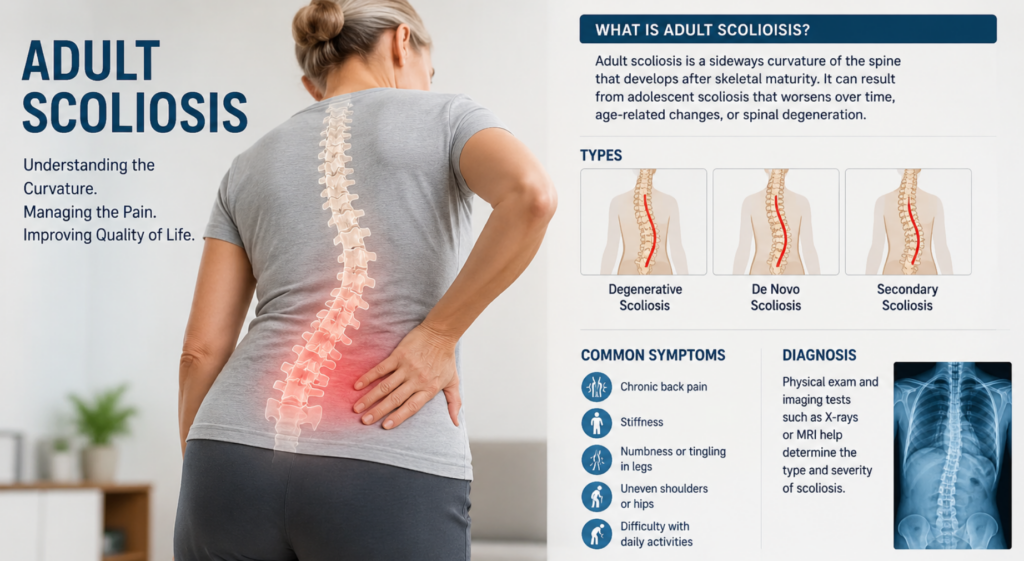
Scoliosis is more than just a curve in the spine. While many people associate scoliosis with posture changes, the condition can affect the entire body, including muscles, joints, nerves, breathing, and overall mobility. Depending on the severity of the spinal curve, scoliosis may cause chronic pain, reduced flexibility, fatigue, and even impact daily activities.
If you live in Miami, Plantation, Port St. Lucie, or anywhere in South Florida, understanding how scoliosis affects the body can help you recognize early symptoms and seek appropriate treatment before the condition worsens.
In this guide, we’ll explain how scoliosis impacts different parts of the body, common symptoms, treatment options, and when it’s time to consult a spine specialist.
What Is Scoliosis?
Scoliosis is a medical condition in which the spine curves sideways, often forming an “S” or “C” shape instead of remaining straight. While mild scoliosis may not cause noticeable symptoms, moderate to severe curves can lead to pain, posture changes, and functional limitations.
Scoliosis can affect:
- Children and adolescents (Idiopathic Scoliosis)
- Adults due to age-related spinal degeneration
- Individuals with congenital spinal abnormalities
- Patients with neuromuscular disorders
Although scoliosis can occur at any age, adults often develop symptoms because of arthritis, disc degeneration, or previous untreated spinal curvature.
How Scoliosis Affects the Entire Body
- Changes Your Posture
One of the earliest signs of scoliosis is uneven body alignment.
You may notice:
- One shoulder sits higher than the other
- Uneven hips
- Rib cage protruding on one side
- Head not centered over the pelvis
- Clothing fitting unevenly
As the curve progresses, maintaining proper posture becomes increasingly difficult.
- Causes Back and Neck Pain
Although many children with scoliosis experience little discomfort, adults frequently develop chronic pain.
The abnormal curvature places extra stress on:
- Spinal joints
- Discs
- Muscles
- Ligaments
This uneven pressure often causes:
- Lower back pain
- Mid-back pain
- Neck stiffness
- Muscle spasms
- Persistent soreness
Pain may worsen after standing or walking for long periods.
- Creates Muscle Imbalances
When the spine curves, muscles on one side become overstretched while the opposite side becomes tight.
This imbalance can result in:
- Muscle fatigue
- Reduced flexibility
- Limited range of motion
- Frequent muscle tension
- Difficulty maintaining balance
Many patients report feeling stronger on one side of the body than the other.
- Affects Walking and Balance
A curved spine changes how body weight is distributed.
Over time, scoliosis may affect:
- Walking mechanics
- Coordination
- Stability
- Balance
- Standing posture
Patients may notice one leg appears longer due to pelvic tilt, even when both legs are actually the same length.
- Places Extra Pressure on the Spine
Every movement places force on the spinal column.
With scoliosis, these forces become uneven, accelerating wear and tear.
This may contribute to:
- Herniated discs
- Degenerative disc disease
- Facet joint arthritis
- Spinal stenosis
These conditions can significantly increase pain as people age.
- Can Compress Nerves
As spinal curves become more severe, nearby nerves may become compressed.
Common symptoms include:
- Leg pain
- Tingling
- Numbness
- Weakness
- Sciatica
Some patients experience symptoms that radiate from the lower back into the hips or legs.
- May Affect Breathing
Severe scoliosis involving the upper spine can reduce the amount of space available for the lungs.
As the rib cage twists, lung expansion becomes more difficult.
Symptoms may include:
- Shortness of breath
- Difficulty exercising
- Reduced endurance
- Fatigue
This is generally seen in more advanced cases.
- Can Impact Digestion
Although uncommon, severe spinal curves may place pressure on abdominal organs.
Some individuals report:
- Feeling full quickly
- Digestive discomfort
- Acid reflux
- Constipation
These symptoms occur when spinal deformity alters the positioning of internal organs.
- Causes Fatigue
The muscles surrounding the spine must work harder to keep the body upright.
This increased effort often leads to:
- Daily fatigue
- Muscle exhaustion
- Reduced stamina
- Difficulty performing physical activities
Many adults describe feeling tired after routine tasks.
- Affects Mental and Emotional Well-Being
Living with chronic pain and visible posture changes can impact emotional health.
Some patients experience:
- Lower self-confidence
- Anxiety
- Depression
- Reduced participation in activities
- Social withdrawal
Seeking treatment early may improve both physical and emotional well-being.
Symptoms You Shouldn’t Ignore
Contact a spine specialist if you experience:
- Persistent back pain
- Uneven shoulders
- One hip higher than the other
- Rib prominence
- Difficulty standing upright
- Numbness or tingling
- Leg weakness
- Progressive spinal curvature
- Balance problems
Early evaluation often leads to better treatment outcomes.
How Scoliosis Is Diagnosed
A spine specialist typically performs:
Physical Examination
The physician evaluates posture, flexibility, muscle strength, and spinal alignment.
Imaging
Common imaging tests include:
- X-rays
- MRI
- CT scan (when necessary)
These images help determine the degree of spinal curvature and whether nerves are affected.
Treatment Options for Scoliosis
Treatment depends on:
- Age
- Severity
- Symptoms
- Progression of the curve
- Overall health
Observation
Small curves without symptoms may simply require routine monitoring.
Physical Therapy
Physical therapy may improve:
- Core strength
- Flexibility
- Posture
- Balance
- Pain management
Medications
Your physician may recommend medications to help reduce pain and inflammation.
Lifestyle Changes
Healthy habits can support spinal health, including:
- Maintaining a healthy weight
- Regular exercise
- Proper posture
- Avoiding smoking
- Strengthening core muscles
Minimally Invasive Spine Procedures
When conservative treatments fail, minimally invasive procedures may relieve nerve compression while preserving surrounding tissues.
Spine Surgery
Surgery may be considered if:
- The curve continues progressing
- Pain becomes severe
- Nerve damage develops
- Breathing becomes affected
- Daily activities become difficult
Modern surgical techniques aim to correct spinal alignment while minimizing recovery time whenever possible.
When to See a Spine Specialist in Miami
You should schedule an evaluation if:
- Your back pain lasts more than several weeks.
- Your posture has noticeably changed.
- You experience numbness or weakness.
- Walking becomes difficult.
- Pain interferes with work or daily life.
- Previous scoliosis symptoms are worsening.
Patients throughout Miami, Plantation, Port St. Lucie, and surrounding Florida communities can benefit from early diagnosis before scoliosis leads to permanent spinal damage.
Can Scoliosis Be Prevented?
Most forms of scoliosis cannot be prevented.
However, early diagnosis can significantly reduce long-term complications.
Regular medical checkups, especially during adolescence, help identify spinal curvature before it progresses.
For trusted public health information about scoliosis, visit the National Institute of Arthritis and Musculoskeletal and Skin Diseases (NIAMS):
Conclusion
Scoliosis affects much more than the appearance of your spine. Left untreated, it can influence posture, muscles, joints, nerves, breathing, mobility, and overall quality of life. While many cases are mild, progressive scoliosis deserves prompt evaluation to prevent future complications.
If you notice persistent back pain, uneven shoulders, changes in posture, or numbness, don’t ignore the symptoms. Early diagnosis and individualized treatment can help you stay active, reduce pain, and protect your long-term spinal health.
Frequently Asked Questions
Can scoliosis cause pain in adults?
Yes. Adults commonly experience chronic back pain, muscle fatigue, stiffness, and nerve-related symptoms due to scoliosis.
Does scoliosis always get worse?
Not always. Mild cases may remain stable for years, while others progress over time, especially in adulthood due to spinal degeneration.
Can scoliosis affect breathing?
Yes. Severe spinal curves involving the upper back can reduce lung capacity and make breathing more difficult.
Is surgery always necessary?
No. Most patients begin with conservative treatments such as physical therapy, exercise, pain management, and monitoring. Surgery is generally reserved for severe or progressive cases.
Can adults develop scoliosis later in life?
Yes. Degenerative scoliosis can develop as the spine ages due to arthritis, disc degeneration, and joint wear.
When should I see a spine specialist?
You should seek evaluation if you have persistent back pain, worsening posture, numbness, weakness, balance issues, or noticeable spinal curvature.
Elite Spine Health & Wellness
If you’re experiencing symptoms of scoliosis or chronic back pain, the experienced team at Elite Spine Health & Wellness is here to help. We provide comprehensive evaluations and personalized treatment plans for patients in Miami, Plantation, Port St. Lucie, and throughout South Florida. Our goal is to relieve pain, improve mobility, and help you return to an active lifestyle using the most appropriate treatment options for your condition.
📞 Call Elite Spine Health & Wellness today: (954) 223-5483 to schedule your consultation and take the first step toward better spine health.